Why your jobs are living in WhatsApp threads and what it’s costing you
TL;DR
FoxTrak replaces scattered WhatsApp threads, SMS chains and email updates with a single job record where every message, photo, approval and payment lives in one place. Every customer action is automatically logged and timestamped. When a job is complete, the entire history exports as a PDF report.
Open your phone right now.
Somewhere in there is a WhatsApp thread with a customer. Probably several. Maybe a group chat with your team about a job. An SMS chain where someone approved something verbally but you can’t find it now. An email thread that started three months ago and has 47 replies.
That’s where your business lives. Scattered across five apps, three devices, and a dozen conversations that have no connection to each other or to the actual job.
You’re not alone. This is how most service businesses operate. It works, until it doesn’t.
The moment it breaks
It always breaks at the worst time.
A customer says they never approved that change. You know they did, but the message is buried in a WhatsApp thread from six weeks ago and you’re spending twenty minutes scrolling to find it.
A team member asks what the customer wanted for step three. You told them last Tuesday. In a text. Which you’d have to forward, except you can’t find it either.
A job is done and it’s time to invoice. You need to reconstruct what was agreed, what was changed, what was added. You’re piecing it together from three different apps like a detective working a cold case.
This isn’t a communication problem. It’s a structure problem. The information exists. It’s just everywhere except where it needs to be.
What scattered communication actually costs
Most service businesses don’t count the cost of communication chaos because it’s invisible. It’s not a line item on an invoice. It’s just… time. Attention. Energy.
But add it up:
Twenty minutes a day searching for messages and context. That’s over 80 hours a year, two full working weeks, spent finding things that should be findable in seconds.
Every “just checking in” message from a customer costs you flow. You stop what you’re doing, you context-switch, you reply, you try to get back into the work. Research on deep work suggests it takes 23 minutes to fully regain focus after an interruption. A few of those a day and your afternoon is gone.
Missed approvals mean rework. Rework means cost. Cost means margin that disappears without anyone noticing where it went.
And the customer experience? Inconsistent. Some customers get quick replies. Others wait. Some feel informed. Others feel ignored. The quality of your communication depends entirely on how busy you are that day, not on any system you’ve built.
Why WhatsApp feels right but isn’t
WhatsApp feels like the right tool because your customers are already on it. No friction, no setup, direct line to the person paying you.
But WhatsApp was built for personal communication, not business operations. It has no concept of a job. No record of what was agreed. No connection between the conversation and the invoice. No way to assign a message to a team member. No audit trail. No export.
When a customer messages you on WhatsApp they get you: your personal attention, your personal time, your personal response. That feels good to them. It scales terribly for you.
The more customers you have, the more threads you’re managing. The more team members you add, the more fragmented the communication becomes. The more jobs you run simultaneously, the higher the chance that something important gets missed in a thread nobody checked.
WhatsApp is a personal communication tool doing a job it was never designed for.
What the job should look like
Every job has a natural structure. There’s a beginning: the quote, the brief, the deposit. There’s a middle: the work, the stages, the progress. There’s an end: the delivery, the approval, the invoice, the payment.
All the communication that happens around a job belongs inside that structure. Not in a separate app. Not in a personal thread. Inside the job itself, tied to the step it relates to, visible to everyone who needs to see it.
When a customer approves something, that approval should live in the job record, timestamped, attributed, permanent. When a team member leaves a note, it should be tied to the step they’re working on. When a message goes out to the customer, it should be logged against the job automatically.
Not because you’re paranoid. Because that’s how professional operations work. Every action, every decision, every communication, on the record, in context, findable in seconds.
How FoxTrak replaces the chaos
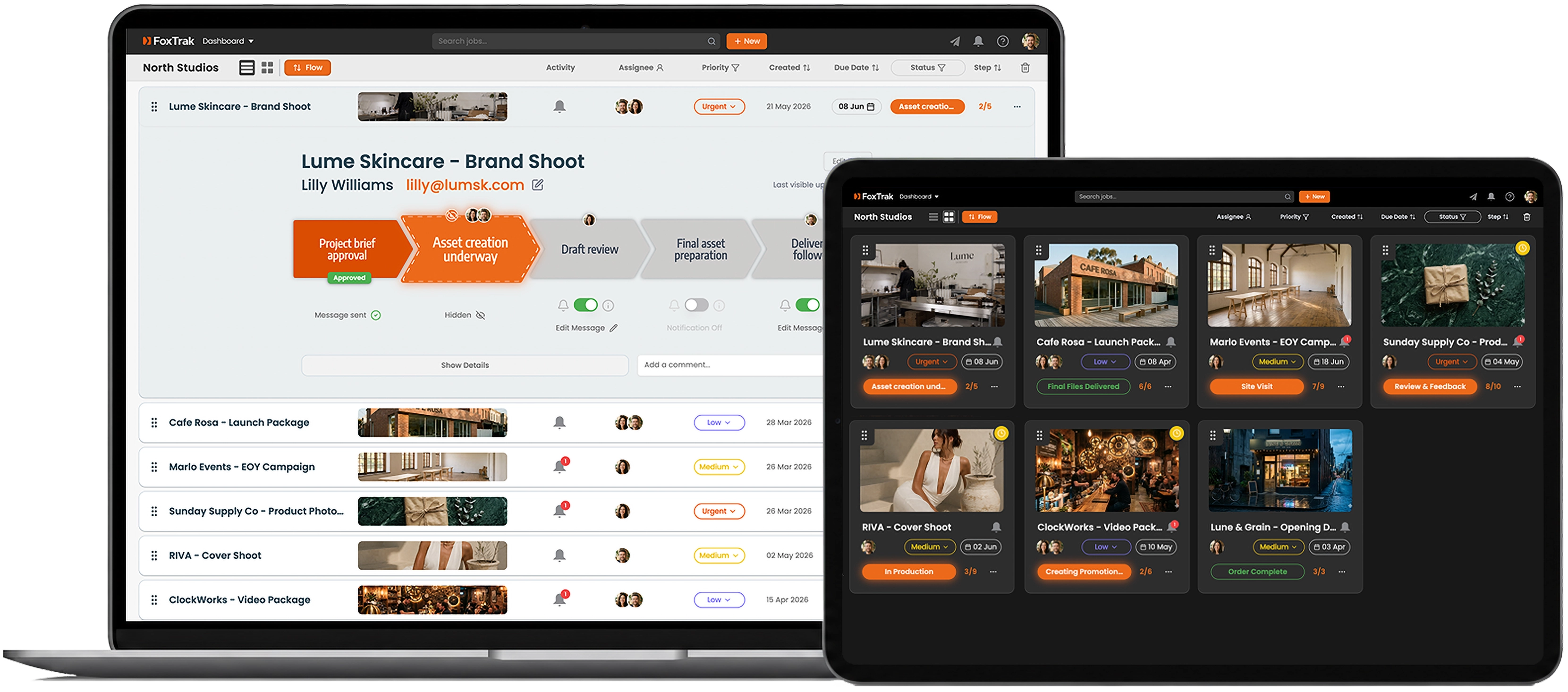
FoxTrak puts everything in one place, but more importantly, it puts everything in the right place.
Every job has a live tracking page your customer can see. Every step has a team member assigned to it. Every message to the customer, from the customer, or between team members, lives inside the job in order.
When you mark a step, your customer is notified automatically. They don’t need to WhatsApp you to find out what’s happening. They already know.
When a customer approves a quote, that approval is logged against the job instantly. You’re notified the moment it happens. No chasing, no “did you see my message?”, no verbal agreements that disappear.
When the job is done, every step, every update, every approval, every team action exports as a full PDF report. Proof of work. Complete history. Everything that happened, in order, on the record.
Your team sees who’s up next. Your customer sees where their job is at. You see the whole picture. One place. No chaos.
The real cost of doing nothing
The WhatsApp thread approach works well enough that most businesses never change it. Until a dispute. Until a key team member leaves and takes the conversation history with them. Until a customer claims they never approved something you know they did but can’t prove.
The businesses that move to structured job communication don’t do it because they’re in crisis. They do it because they can see the ceiling and want to grow past it without the wheels falling off.
A painter in Melbourne used to manage jobs through a combination of SMS, WhatsApp, and memory. This week he ran his first job through FoxTrak. His customer got an SMS update the moment the first step was marked. The approval is on record. The communication is inside the job.
He’s not going back.
Getting started
FoxTrak is free to start, no credit card, no time limit on the free plan. Your first job live in minutes.
If you’d rather see it in action first, there’s a 75-second overview video.
The WhatsApp thread isn’t a communication strategy. It’s a workaround. And you’ve outgrown it.
Frequently asked questions
Why shouldn’t I use WhatsApp to communicate with customers about jobs?
WhatsApp was built for personal communication, not business operations. It has no job structure, no audit trail, no way to assign messages to team members, and no record of approvals. It works for small volumes but creates expensive chaos as your business grows.
What’s the best way to manage customer communication on jobs?
Keep all communication inside the job itself, tied to the step it relates to, visible to your team, and automatically logged. FoxTrak does this by giving every job a live tracking page where customer messages, team chat, approvals, and updates all live in one place.
How do I stop losing important messages and approvals in WhatsApp threads?
Move job communication into a structured system where every message, approval, and update is tied to the specific job and step it relates to. FoxTrak logs every customer action automatically. Approvals, payments, and feedback are all stored inside the job so nothing gets lost.