How builders keep clients informed during a long project
TL;DR
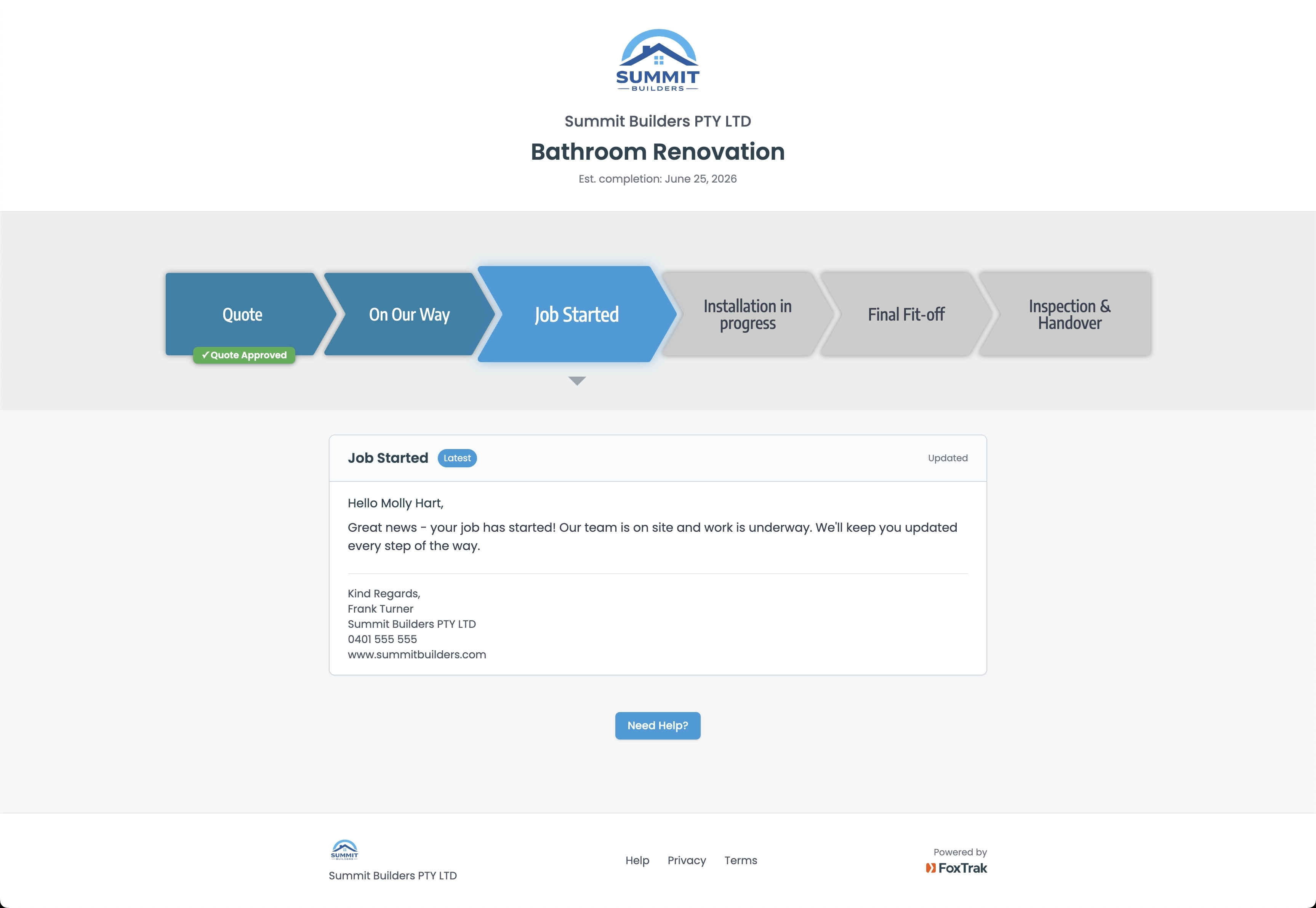
FoxTrak gives every build a live tracking page the client can check any time, from quote through to handover. When you move a job to the next stage, the client is notified automatically, and if a due date shifts, FoxTrak prompts you to explain why before the tracker updates. No app, no login, no chasing.
A long build creates a long wait. And most builders manage that wait the same way.
A text when the job starts. A call at a few key milestones. Maybe a check-in if the client reaches out first. Then a final call when it’s ready for handover.
It works, until the gaps in between start to feel longer than they should.
The long project communication problem
The work itself is rarely the issue. Foundations take the time they take. Framing happens on its own schedule. Trades show up when they show up. Clients generally understand that.
What they don’t have is visibility into any of it.
So weeks pass with nothing. The client starts wondering if things are on track. They don’t want to be the annoying one calling every fortnight, so they wait a bit longer before reaching out. Eventually they do, and now they’re the one tracking the job, because nobody else is doing it for them.
That’s the real cost. Not the wait itself. The not knowing.
Why silence costs more than delay
Picture a renovation that runs four months longer than first discussed, not from anything dishonest, just the normal complications of trades, weather, and supply delays that comes with any build. For the first few weeks the client doesn’t think much of it. By month two, they’re the one calling for updates. By month three, they’ve started keeping their own notes on what was promised and when.
Then a cost comes up. Something legitimate, a material substitution, an unexpected site issue, a scope change the client actually asked for. In a relationship with good visibility, that’s just a normal update. In a relationship that’s gone quiet for months, it reads as something being pulled on them, even when it’s completely fair.
This is the pattern behind most client friction on long jobs. It’s rarely about price or delay on their own. It’s that the client had to become the project manager on their own project, and once that happens, trust is already thin before the next change even lands.
How FoxTrak works for builders
FoxTrak gives every build a live tracking page the client can check any time, built around the stages of your actual workflow.
A typical build might move through something like:
Quote → Deposit → Site Prep → Slab and Foundations → Frame Up → Fit Out → Handover
Every stage is yours to name and reorder however your business actually runs. When you mark a stage complete, your client’s tracker updates automatically and they’re notified by email, SMS, or push notification, whichever they prefer. No login, no app required, though one’s there if they want it.
If the due date changes, which happens on real builds, FoxTrak prompts you to send a short note explaining why before the tracker updates. The client hears the reason directly from you, in context, instead of just noticing a date move and wondering what happened.
Your team stays in the loop too. Assign a stage to whoever’s responsible for it and they’re notified the moment it’s their turn to act.
The bigger picture for builders
Building work runs on reputation. Referrals, repeat clients, word of mouth in a suburb where everyone talks to everyone. The builders who get referred the most aren’t always the ones with the fastest jobs. They’re the ones whose clients never had to wonder what was happening.
A client who can check progress whenever they like, see exactly what stage things are at, and gets told the why behind any change, isn’t chasing you. They’re telling their friends the process was easy. That’s the conversation that gets you the next job before this one’s even finished.
Getting started
FoxTrak is free to start, no time limit on the free plan. Map your build stages once and have your first client tracking the job within minutes.
The longer your projects run, the more this pays off.
Frequently asked questions
Is FoxTrak only suited for quick jobs?
No. Long projects benefit more from a live tracker, not less. The longer a job runs, the more room there is for silence to build up between updates, and the more it matters that clients can check progress without having to ask.
How do builders keep clients informed during a long project?
FoxTrak gives every job a live tracking page the client can check any time. When you mark a stage complete, the tracker updates automatically and the client is notified by email, SMS, or push notification.
What happens when a project’s due date changes?
FoxTrak prompts you to send a short explanation before the tracker updates, so the client hears the reason from you directly instead of just seeing a date move.